
Abstract
Background:
Attention to the lack of diversity in the health care workforce is increasing. One approach to addressing this issue is to create pathways programs to introduce learners from underrepresented backgrounds to various health care professions. Pathways programs are known within dentistry, but are limited because of their resource intensity. This study was undertaken to examine the impact of a pathways program on the interest of underrepresented youth in health care careers, including dentistry.
Methods:
This case study describes a 5-day pathways program (“camp”) organized by volunteer medical students in 2022 and 2023. Before and after the week-long camp, participants completed a survey to gauge interest in various health care careers.
Results:
Participants’ interest in pursuing a career in dentistry increased significantly, from 8% (6/75) before to 36% (31/86) after the camp (Z = −4.555, p < 0.001).
Conclusions:
This medical pathways program resulted in a significant increase in participants’ interest in a career in dentistry, which suggests that the resource barriers associated with pathways programs could be mitigated through interprofessional collaboration. In particular, dental training programs could work alongside medical counterparts to offer health care pathways programs, rather than creating dentistry-specific pathways programs. This could reduce resource demands on each individual training program while promoting increased diversity among health care professionals.
Keywords:
Diversity, equity, inclusion, pathway program, dental education
Introduction
It is of persistent concern that the diversity of health care professionals does not adequately represent the diversity of the patients whom we serve.1,2 For example, just 0.12%, 5.84% and 10.3% of applicants to dental schools in the United States in 2024 were Indigenous, Black and Latino,3 respectively, whereas these 3 groups represented 1.3%, 13.7% and 19.5% of the US population.4 At the time of the current study, no similar Canadian studies were available, and only 2 Canadian dental schools made limited sociodemographic data publicly available on their websites. The University of Alberta (Edmonton) reported that 3%–6% of its dental school cohorts were Indigenous in the 2024 and 2025 admission cycles,5 in contrast to 9.4% of the Canadian population.6 At Western University (London, Ontario), 2% of dental school matriculants in the 2024 admission cycle were Black,7 in contrast to 4.3% of the Canadian population.8 Given that greater diversity within health care teams is associated with improved patient outcomes,9 institutions offering health professions education (HPE) are called to increase representation among their matriculated trainees.
Strategies to increase diversity with a view to equitable access include offering help to prepare for both the Dental Admission Test (DAT) and admission interviews, as well as fee assistance and mentorship initiatives.1 Another strategy is the use of pathways programs, which equip pre-HPE students to successfully apply for health care programs. Learners from backgrounds that are underrepresented in health care careers often lack social capital, such as existing networks or connections through family members or friends that can help them achieve their career goals. Pathways programs aim to facilitate access for these students to help them succeed in pursuing health care careers.10,11 Previous studies have demonstrated the effectiveness of pathways programs. For example, one long-standing postbaccalaureate pathways program based in San Francisco, California, and designed for learners of low socioeconomic status who had previously been denied admission to dental school, reported longitudinal outcomes.12 Among the 94 participants, DAT scores improved significantly, and 98% were accepted into dental school. Furthermore, of the participant alumni who were surveyed, 81% were working with underserved populations.
The challenge presented by pathways programs, however, is the intensity of resources required to implement effective programs that will generate a meaningful difference in applicant diversity. As the largest-scale and most-cited example in dentistry, one pathways program organized over 5 years across 15 dental schools in the United States resulted in an increase in enrolment of underrepresented students by 54%, in contrast to 16% over the same period in nonparticipating schools.13 Despite the success of this initiative, its impact on diversity nationally was limited.14 This result highlights a gap in the literature about how to create substantial change in the diversity of HPE programs, given the resources required to organize pathways programs. Here, we illustrate how diversity within dentistry may be increased by collaborating with interprofessional pathways programs to mitigate the logistical costs of organizing such initiatives.
The first step in increasing diversity in the health care workforce is to encourage target populations to consider health care careers.11 With this in mind, the objective of this study was to examine the potential impact of one institution’s medical pathways program on stimulating interest among underrepresented youth in pursuing a career in health care.
Methods
This study received ethics approval from the University of Alberta Human Research Ethics Board. The pathways program serving as our case study was the Asclepius Medical Camp for Youth (referred to hereafter as “Asclepius”), which invites youth from underrepresented backgrounds to explore careers in health care.15 Since its inception in 2009 for about a dozen participants, this annual 5-day summer camp hosted at the University of Alberta medical school has since expanded to offer programming to 50 high-school-aged youth per year. The medical school is part of the combined Faculty of Medicine and Dentistry, allowing for cross-pollination between the 2 areas of health care.
The data for this study came from camps organized by medical student volunteers that took place July 18–22, 2022, and July 17–21, 2023. Each camp offered 8 hours of programming per day. The camps were designed to be inclusive and equitable and were free to attend, with transportation passes and lunch included. A typical program day included a medical lecture, a guest speaker panel, case-based learning in small groups, a game, a physical examination skills session and a procedural skills session. Although most of the camp’s programming was geared toward informing youth about a career as a physician, the program incorporated guest speakers and activities illustrating a variety of health care careers. In a few prior years, the Asclepius camps included a hands-on dental hygiene skills session, but this was not part of the program in 2022 and 2023, and there were no formal dentistry-themed activities during these 2 years. Volunteers did not receive specific training with respect to careers in dentistry but were trained during their orientation to regularly check in with camp participants, on an informal basis, about various health care careers. Furthermore, pamphlets about the university’s dentistry program were included in participants’ welcome kits.
Each year, Asclepius participants are invited to complete surveys to assist with program evaluation. Survey respondents provide informed consent, and completion of the survey does not affect eligibility to participate in the camp. The survey was originally developed by Asclepius camp organizers in 2016 and has been revised and revalidated each year based on responses and input from participants, as well as the quality improvement interests of the student volunteers (with input from faculty experts). The responses to the 2022 and 2023 surveys were selected for this study because 2 new questions were added regarding sociodemographic characteristics and barriers (Table 1, showing only survey questions pertinent to this study). All of the Asclepius participants in 2022 and 2023 were invited to complete the survey before and after attending the camp, according to usual practice. Survey responses were anonymous, so the pre- and post-camp responses could not be paired. The survey asked participants about their interest in and knowledge about health care careers. Participants were not asked to report specific sociodemographic characteristics, to ensure cultural safety and to make responses less identifiable, but were asked more generally whether they self-identified as 1 of 3 underrepresented ethnicities at the local medical school and whether they self-identified as facing a barrier to entering this career (Table 1).
|
Question |
Answer options |
|---|---|
|
Note: EMT = emergency medicine technician. |
|
| Aside from being a physician, are there other health care professions that you are interested in? |
|
| The University of Alberta has identified three groups that face institutional barriers to careers in medicine and are thus underrepresented in medical school: Black, Indigenous, and Filipino. Do you self-identify as belonging to one of these three groups? | Yes No |
| This camp is aimed for students that are facing barriers (socioeconomic or otherwise) to entering medical school and/or a career in medicine. Are you a part of this population of students? | Yes No |
We used SPSS 23 software (IBM Corporation, Armonk, NY) for descriptive analyses. We used the Z-test to compare proportions because the sample was sufficiently large for a normal approximation to the binominal distribution and because the pre- and post-camp survey results were unpaired.
Results
Fifty youth participants attended the camp each year in 2022 and 2023. We received a total of 75 responses to the precamp survey, with response rates of 78% (39/50) for 2022 and 72% (36/50) for 2023. We received a total of 86 responses to the postcamp survey, with response rates of 80% (40/50) for 2022 and 92% (46/50) for 2023. For sociodemographic data (based on the precamp survey), 51% (20/39) and 61% (22/36) of survey respondents in 2022 and 2023, respectively, self-identified as belonging to an underrepresented ethnicity. Furthermore, 44% (17/39) and 53% (19/36) of respondents in 2022 and 2023, respectively, self-identified as facing a barrier (socioeconomic or otherwise) to pursuing a career in a health care profession.
In both the pre- and post-camp surveys, participants were asked to indicate their interest in a health care career other than “physician” from a set list, with an open-text space to specify other interests. The options listed in the survey were dentist, medical laboratory technologist, nurse, occupational therapist, paramedic/EMT (emergency medical technician), pharmacist, physical therapist, radiology technician and speech-language pathologist.
In the precamp surveys (2022 and 2023 results combined), the top 3 professions selected were pharmacist (48%, n = 36/75), medical laboratory technician (47%, n = 35/75) and nurse (44%, n = 33/75). In the postcamp surveys, the top 3 professions selected were nurse (43%, n = 37/86), pharmacist (40%, n = 34/86) and dentist (36%, n = 31/86). The proportion of respondents who selected dentistry increased significantly from the pre-camp to the post-camp survey (8% [n = 6/75] and 36% [n = 31/86], respectively; Z = −4.555, p < 0.001) (Figure 1). No other professions had a similar increase in interest, and one profession (medical lab technologist) had a decrease in interest (p < 0.05) (Figure 1).
Figure 1: Participants’ interest in allied health careers, based on surveys completed before and after participation in the Asclepius Medical Camp for Youth (data for 2022 and 2023 combined).
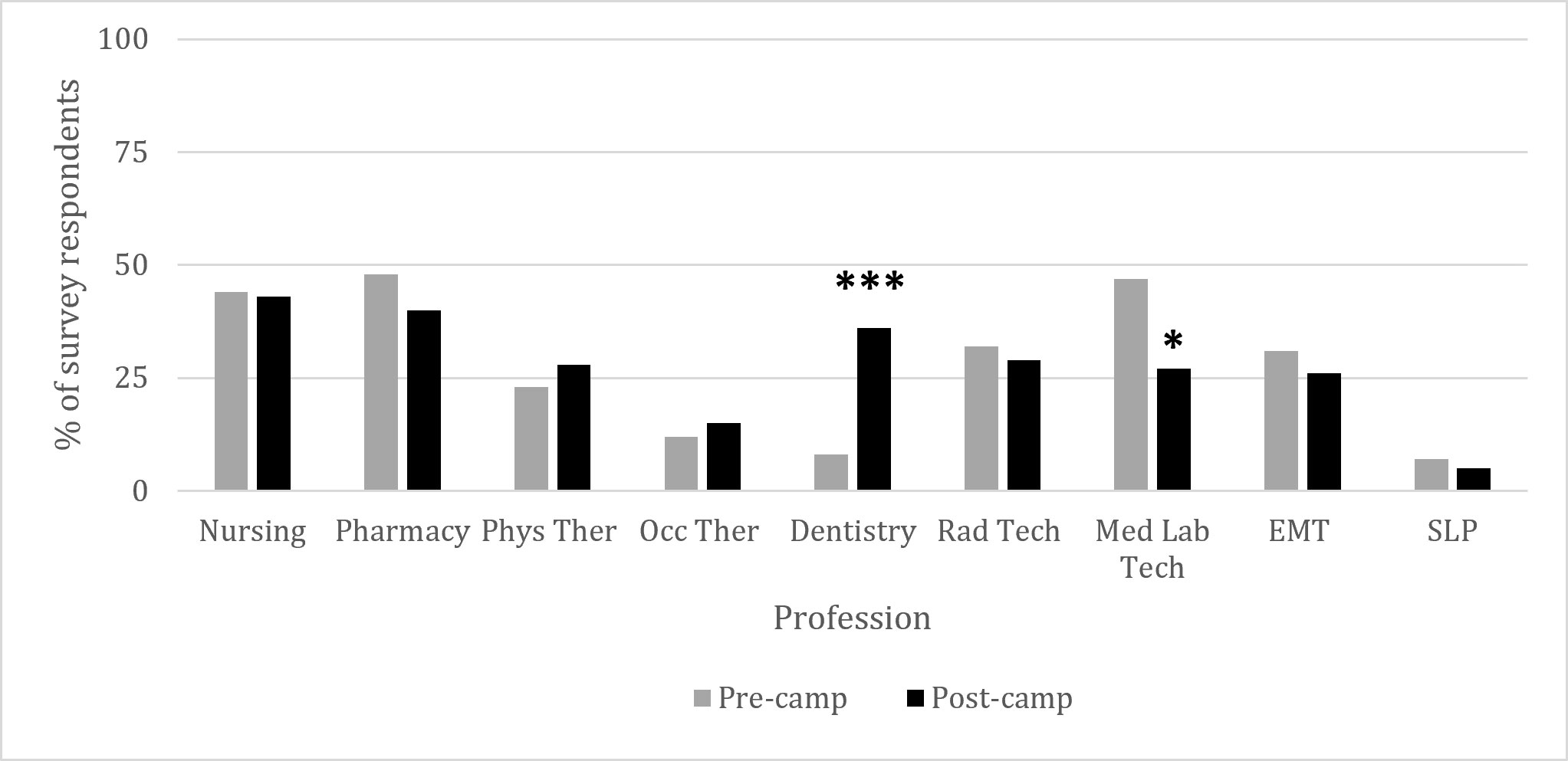
Phys Ther = physical therapy, Occ Ther = occupational therapy, Rad Tech = radiation technology, Med Lab Tech = medical laboratory technology, EMT = emergency medicine technology, SLP = speech–language pathology. *Statistically significant difference between pre- and post-camp results, p < 0.05. ***Statistically significant difference between pre- and post-camp results, p < 0.001.
In the precamp survey, students listed “other” health career interests as cardiothoracic surgeon, microbiologist, neurosurgeon, ophthalmologist, psychiatrist, psychologist, public health and veterinarian. In the postcamp survey, students listed “other” health career interests as medical examiner, mortician, mental health professional, microbiologist, midwife, neurologist, psychiatrist and veterinarian.
Discussion
This study yielded an unanticipated finding: our pathways program, which was intended to increase interest in medical school among high-school-aged youth, also produced a significant increase in interest in a career in dentistry. This unexpected outcome inspired our team to consider the potential of pathways programs to foster interprofessional collaboration. Although the mechanism driving this increase in interest was unclear, we propose that this result can be seen as a call to action for HPE programs to find strength in jointly organizing programming for underrepresented learners, thereby increasing diversity across a variety of health disciplines. Only a few studies have measured the longitudinal outcomes of pathways programs, but the objective evidence supports such programs as one element of an overall strategy to increase diversity in health professions.2,12,13
Hewlett and colleagues2 reviewed dental pathways programs in 2022, concisely synthesizing a list of evidence-based best practices for these programs, including formal mentorship, exposure to faculty, financial assistance and shadowing at local minority practices. However, the substantial input of resources required to coordinate such initiatives is a major factor limiting the realization of pathways programs. In this regard, Hewlett and colleagues2 acknowledged that “most in-depth analyses to date … benefit from scales of project scope, datasets, and resources unattainable for programs initiated and conducted by individual dental schools.” Such resources include funding, equipment and facilities, materials required for hands-on activities, guest speakers and volunteers, and recruitment efforts.2,10 As a result, pathways programs designed to create a meaningful impact can quickly become resource-intensive.
Given the limitations that any single HPE institution will experience in developing a pathways program, paired with a lack of practical recommendations to overcome such resource constraints, we propose that dentistry programs consider collaborating with existing local medical pathways programs to achieve successful outreach to underrepresented youth. Such mutually beneficial collaboration is achievable given the large number of medical pathways programs already in existence. For example, one study identified 658 such programs in the United States in 2021.16 Hewlett and colleagues2 alluded to the approach of addressing resource limitations through collaboration with medical pathways programs, recognizing that there may be similarities between dentistry and medicine that could be conducive to inspiring interest in each field. In the current study, we observed a significant increase in interest in the dental profession among participants in the medical pathways program, which demonstrates a valuable overlap in interests.
Most published findings about pathways programs for dentistry have come from the United States. In one of the few Canadian studies, Ardenghi and colleagues17 described a successful example of interprofessional collaboration between pathways programs, specifically a 5-day pathways program that exposed participants from underrepresented backgrounds to a variety of health care professions, including dentistry (with a dental simulation activity). The authors noted that this collaboration had the practical benefit of reducing the cost for each participating HPE program. Furthermore, one review of the current dentistry landscape suggested a “major re-investment” in pathways programs to address persistent deficits in diversity, noting the importance of interprofessional programs.1 Our findings offer further support for this call to action. At our institution, for example, the local dentistry program would benefit logistically from collaborating with the existing medical pathways program, an approach that could significantly reduce logistical costs that would otherwise be incurred by creating a separate initiative while reaching the same target audience.
Our study was strengthened by the availability of data for multiple years from a relatively large pathways program. Conversely, this single-institution, 2-year study was limited by the absence of intervention and control cohorts. Furthermore, the study was retrospective, based on the unanticipated discovery of an increase in interest in dentistry among youth participants in a medical pathways program. Future studies should prospectively characterize the benefit of collaboration between dental schools and medical pathways programs.
It is important to note both the dearth of publications about Canadian dentistry pathways programs and the lack of Canadian data regarding demographic characteristics of dentistry students. Regardless of whether these information gaps arise from a lack of studies in these areas or a lack of venues for publication, the difficulty we experienced in finding this information highlights an area of need for future research. Canadian dentistry education research would greatly benefit from future studies characterizing the demographic profile of Canadian dentistry students to track the efficacy of diversity initiatives over time.
Conclusion
This study yielded a specific, pragmatic and actionable conclusion: to mitigate the cost of resources for pathways programs to improve diversity in the health care workforce, HPE programs should seek interprofessional collaboration. In particular, we recommend that dental educational institutions approach and collaborate with existing medical pathways programs, which are numerous and generally accessible. At the same time, it must be recognized that pathways programs represent just one strategy among the many grassroots- and institutional-level changes required to produce meaningful improvements in diversity and equity within the dental profession. Working together, we can strengthen pathways programs as one aspect of improving diversity in health care professions, thereby improving patient care for the future.
THE AUTHORS
 |
Dr. Ross is professor, department of family medicine, University of Alberta, Edmonton, Alberta. |
 |
Dr. Papp is resident, department of ophthalmology and visual sciences, University of British Columbia, Vancouver, British Columbia. |
 |
Dr. Shang is a resident, department of medicine, University of Calgary, Calgary, Alberta. |
Corresponding author: Dr. Shelley Ross, Department of Family Medicine, University of Alberta, 6-10 University Terrace, Edmonton, AB T6G 2T4. Email: sross@ualberta.ca
The authors have no declared financial interests.
This article has been peer reviewed.
References
- Garcia RI, Blue Spruce G, Sinkford JC, Lopez MJ, Sullivan LW. Workforce diversity in dentistry – current status and future challenges. J Public Health Dent. 2017;77(2):99-104. doi: 10.1111/jphd.12219
- Hewlett ER, Lobo-Marwah E, Hishaw LB. Dental school pathway programs: Best practices for increasing workforce diversity. J Dent Educ. 2022;86(9):1098-106. doi: 10.1002/jdd.13033
- Singh P, Lawton KB, Istrate EC, Booker CL, West KP. U.S. dental school applicants and enrollees, 2020 entering class. Washington (DC): American Dental Education Association; 2025. Available: https://www.adea.org/home/publications/research-and-data/applicants-enrollees-and-graduates/2024-applicants-and-first-time--first-year-enrollees (accessed 2025 Apr 26).
- United States Census Bureau. Population estimates, July 1, 2024 (V2024). In: QuickFacts. Washington (DC): The Bureau. Available: https://www.census.gov/quickfacts/fact/table/US/PST045224 (accessed 2025 Apr 26).
- Mike Petryk School of Dentistry. Dentistry admission statistics: 2025 intake. Edmonton (AB): University of Alberta. Available: https://www.ualberta.ca/en/school-of-dentistry/programs-and-admissions/dentistry/dds-admission-statistics.html (accessed 2025 Sep 23).
- Statistics Canada. Statistics on Indigenous peoples. Ottawa (ON): Statistics Canada. Available: https://www.statcan.gc.ca/en/subjects-start/indigenous_peoples (accessed 2025 Sep 23).
- Schulich Medicine and Dentistry. Admission statistics. Meet the dentistry class of 2028. London (ON): Western University. Available: https://www.schulich.uwo.ca/med_dent_admissions/dentistry/admission_statistics1.html (accessed 2025 Sep 23).
- Domey N, Patsiurko N. Ethnicity, Language and Immigration Thematic Series. The diversity of the Black populations in Canada, 2021: a sociodemographic portrait. Ottawa (ON): Statistics Canada; 2024. Available: https://www150.statcan.gc.ca/n1/pub/89-657-x/89-657-x2024005-eng.htm (accessed 2025 Sep 23).
- Gomez LE, Bernet P. Diversity improves performance and outcomes. J Natl Med Assoc. 2019;111(4):383-92. doi: 10.1016/j.jnma.2019.01.006
- Anaya YB, Sur D, Moreno G. A guide to building K-12 pathway programs within family medicine residency programs. Fam Med. 2025;57(3):159-67. doi: 10.22454/FamMed.2025.707342
- Parsons M, Caldwell MT, Alvarez A, Davenport D, Gallegos M, Landry A, et al. Physician pipeline and pathway programs: an evidence-based guide to best practices for diversity, equity, and inclusion from the Council of Residency Directors in Emergency Medicine. West J Emerg Med. 2022;23(4):514-24. doi: 10.5811/westjem.2022.2.54875
- Wides CD, Brody HA, Alexander CJ, Gansky SA, Mertz EA. Long-term outcomes of a dental postbaccalaureate program: increasing dental student diversity and oral health care access. J Dent Educ. 2013;77(5):537-47. PMCID: PMC3718543
- Formicola A, Bailit H, D’Abreu K, Stavisky J, Bau I, Zamora G, et al. The dental pipeline program’s impact on access disparities and student diversity. J Am Dent Assoc. 2009;140(3):346-53. doi: 10.14219/jada.archive.2009.0166
- Poole T, Jura M, Taylor G, Gates P, Mertz E. Slipping through the cracks: Just how underrepresented are minorities within the dental specialties? J Public Health Dent. 2022;82 Suppl 1:53-62. doi: 10.1111/jphd.12520
- Papp KM, Krysler AR, Lee S, Ross S. Mini med school: knowledge and resources for underrepresented in medicine youth. Fam Med. 2025;57(3):218-21. doi: 10.22454/FamMed.2024.388919
- Ogunyemi D, Westermeyer C, Eghbali M, Patel P, Struble S, Arogyaswamy S, et al. Seeking equity; pathway programs in liaison committee on medical education medical schools for minoritized students. J Med Educ Curric Dev. 2023;10:23821205231177181. doi: 10.1177/23821205231177181
- Ardenghi DM, Chen JL, Brondani M, Grazziotin R. Engaging equity-deserving groups in dental education. J Dent Educ. 2024;88(Suppl 3):1810-2. doi: 10.1002/jdd.13592