
Abstract
This article reports on the outcomes of an interdisciplinary full-day workshop focused on interprofessional collaboration on providing oral health care for elderly people. The workshop brought together global experts, researchers, and the public to discuss the concept of interprofessional collaboration in oral health care delivery for older populations. The discussions highlighted 6 areas that formed a policy framework for action and included oral health screening integration into primary care, system requirements in terms of funding and infrastructure, and interprofessional collaboration with trained providers focused on patient-related outcomes.
Keywords
Workshop, aging, frailty, oral health care, interprofessional care, integration, allied providers, workforce, Canadian Dental Care Plan
Background
Population aging is the defining demographic shift of the 21st century. Although many older adults are living longer and healthier lives, many experience frailty, multimorbidity and declining functional and cognitive capacity. Oral health is deeply embedded within the broader context of health and disability continuum,1 but oral health care is frequently separated structurally, professionally and financially from general health care, particularly in countries such as Canada.2 However, the introduction of the Canadian Dental Care Plan (CDCP) has brought oral care closer to general health care for low-income residents without private dental insurance.3 Yet, many older adults, especially those who are disabled or frail, face considerable barriers to accessing dental services.4
Oral diseases are preventable and share common risk factors with other non-communicable diseases. This highlights the need to integrate oral health care into primary care involving other non-dental personnel to facilitate early detection, prevention and improved health outcomes.5
An Action Plan
The challenge of oral care for older adults led to the organization of an interdisciplinary and multi-sectorial full-day workshop on April 24, 2026, at the University of British Columbia (UBC) Faculty of Dentistry titled Interprofessional aging symposium and workshop: ENGAGE + EDUCATE + ASSESS + CARE. Six academics and researchers from Canadian and international universities representing dentistry, nursing, global health and speech language pathology shared their expertise in dental public health, oral health, clinical epidemiology, dental geriatrics and gerontology, oral pathology, acute care, interprofessional collaboration and person-centered care. The workshop had over 40 attendees, including undergraduate and graduate students from various faculties and universities in BC, frontline workers, long-term care (LTC) facility staff and administrators, health care professionals and patients advocates.
Specifically, the workshop aimed to:
- Understand the relationship between oral health and frailty;
- Examine the structural and systemic barriers limiting access to oral care;
- Explore interprofessional and integrated care models;
- Identify practical strategies for embedding oral health into primary and team-based care;
- Evaluate person-centered approaches to assessment and treatment across different care settings;
- Highlight the role of education, workforce development and policy.
The six presentations addressed these objectives from complementary perspectives. Together, they formed a coherent argument for rethinking oral health care delivery for aging populations across the continuum of care. The presentations were followed by interactive small and large group discussions.6 In this report, we summarize the most important points highlighted during the presentations and discussions and conclude with a suggested roadmap for policy action and future research.
Emerging Findings
- Oral Health as a Public Health and Aging Issue - The evidence presented reinforced that oral health remains a major determinant of health and quality of life in older adults, is closely linked to many systemic conditions, and is an integral part of public health with upstream approaches to the prevention of diseases.7 The cumulative effects of lifelong oral disease combined with aging-related challenges frequently leads to complex care needs and high care dependence in this population. Although edentulism has declined, partial tooth loss, dental caries and other chronic conditions remain highly prevalent, and often require complex and resource-intensive care.8
- Persistent Inequities and Role of the CDCP - The introduction of the CDCP in Canada represents a major policy shift toward reducing financial barriers to dental care. Early data suggest substantial uptake of this program and significant participation by oral health care providers.3 However, the program does not address the broader systemic barriers such as geographic isolation, physical and cognitive limitations, limited service availability in non-traditional settings and lack of integration with primary care.9
- Fragmentation of Care as a Central Problem - Fragmentation of health care for older adults results in poor integration of care, concentration of oral health care delivery within the private sector, lack of shared professional training and communication, weak referral pathways between public and private providers and an absence of oral health assessments in routine care. Such factors lead to late detection of disease, missed opportunity for prevention, and the perpetuation of health care inequities, especially for vulnerable populations and frail older adults.10
- Primary Care Integration as a Practical and Necessary Solution - Integration of oral care with primary care emerged as a central solution to the delivery of oral health care to older adults.11 Successful integration promotes routine screening by non-dental personnel, provides well-defined roles for all health care providers within the team-based care, simplifies referral pathways, enhances patient-centered communication and encourages the development of workflow-compatible tools.
- Interprofessional Workforce and Team-Based Care - Oral health care cannot be delivered solely by oral health care providers in isolation. Nurses, physicians and allied health providers can screen for disease and educate for prevention. It also requires coordinated team-based approaches and shared responsibility across disciplines, including oral health care. However, there are substantial barriers to effective team-based health care approaches, including inadequate oral health education for non-dental personnel, unclear scopes of practice and lack of standardized protocols for shared responsibilities.5
- Program Innovations: UBC Geriatric Dentistry Program - UBC’s Geriatric Dentistry Program demonstrates the feasibility of integrated models through expanded services in LTC, specialized geriatric clinics, interprofessional education and research on oral health outcomes and service delivery. Its curriculum innovations,12 residency programs, and teledentistry initiatives13 demonstrate transformative ways to care for frail older adults by bringing appropriate services to where they are most needed and advocating for undergraduate training of oral health care personnel.
- Challenges in Acute Care Settings - Acute care hospitals represent a challenging environment for oral health care due to the high complexity of patients with multimorbidity and polypharmacy, staffing shortages, competing priorities and limited oral health care services.14 Consequently, oral care is frequently neglected.15 The role of non-dental personnel includes oral health assessment and advocacy, but it is often overlooked and not deemed as a priority.
- Importance of Person-Centered Care and Patient-Reported Outcomes and Measures - Traditional clinical indicators are insufficient for older adults with complex health conditions.16 Care is greatly improved when patient-reported outcomes and measures, functional status and quality of life, and individual values and goals are incorporated into the care plan. Patient engagement in the health care decisions also improves compliance with treatments.
Key Points: A Roadmap
The workshop presentations and discussions highlighted a critical and timely issue: that oral health remains a neglected yet essential component of health care for aging populations. In turn, the participants suggested an integrated oral health framework (Figure 1).
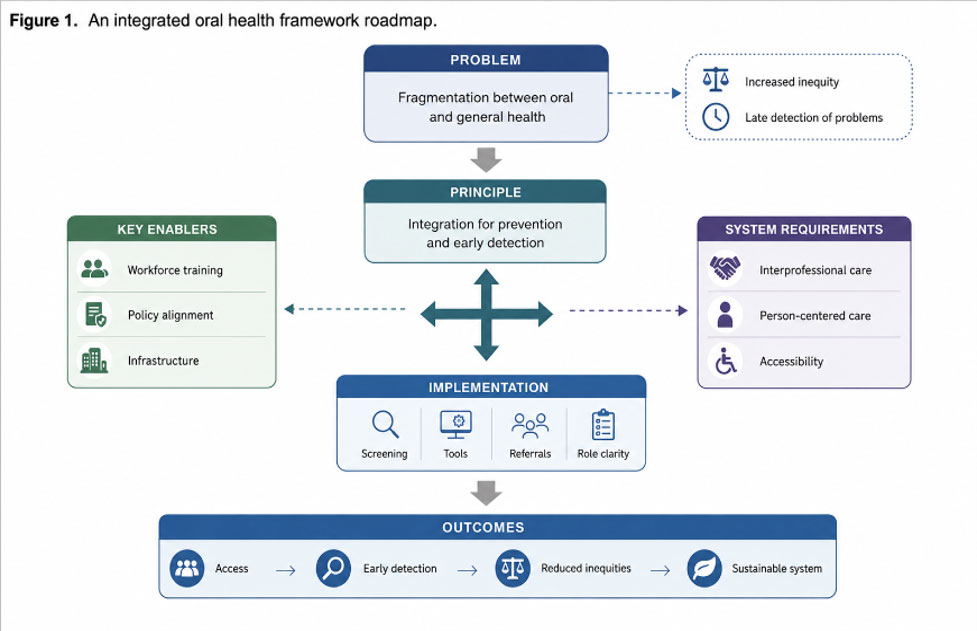
The framework begins with recognition of fragmentation between oral and general health systems, leading to inequities and delayed detection. Integration is positioned as essential for prevention and improved outcomes. Core system requirements include interprofessional collaboration, person-centered care and accessible service delivery. These are supported by key enablers, including workforce development, policy alignment and health care infrastructure. Implementation is achieved through scalable strategies such as routine screening, simplified validated tools, referral pathways and role clarification across providers. The framework culminates in improved access, early detection of oral disease, reduced health inequities, and a more sustainable health system. Ultimately, improving oral health for frail older adults requires coordinated action across research, education, policy and practice.
However, future research is needed to put such a roadmap into practice and assess its feasibility and impact, while keeping in mind the possible limitations of the information that emerged from the workshop based on convenient sampling and limited number of older adults with lived experiences.
Conclusion
- Oral health must be integrated into general health systems.
- Integration is essential for prevention, early detection and improved outcomes.
- Although the CDCP represents meaningful progress, addressing non-financial barriers is equally critical.
- Interprofessional collaboration is crucial.
- Education and workforce development are key enablers to care for frail older adults.
- Person-centered care should guide practice.
- Incorporating patient perspectives and outcomes is essential for meaningful care.
- Simple interventions, such as screening tools and role clarification, can have a significant impact.
- Policy and system-level changes are needed.
THE AUTHORS
 |
Dr. Brondani is a professor, department of oral health sciences, faculty of dentistry, University of British Columbia. Vancouver, British Columbia, Canada. |
 |
Dr. Allison is a professor, faculty of dental medicine & oral health sciences, McGill University, Montreal, Canada |
 |
Dr. Ferretti-Rebustini is an associate professor, faculty of nursing. University of Sao Paulo. Sao Paulo, Brazil. |
 |
Dr. Kafili is a graduate student, faculty of dentistry, University of British Columbia. Vancouver, British Columbia, Canada |
 |
Dr. Noeerazlighi is a graduate Student, faculty of dentistry, University of British Columbia. Vancouver, British Columbia, Canada |
 |
Dr. Pokhrel is a graduate student, faculty of dentistry, University of British Columbia. Vancouver, British Columbia, Canada |
 |
Dr. Ramachandran is a reserach asssiatnt, clinical prevention services, British Columbia Centre for Disease Control, Vancouver, Britsh Columbia, Canada |
 |
Ms. Schreiber is an acute and long-term care speech language pathologist, Vancouver Coastal Health Authority. |
 |
Dr. MacEntee is a professor emeritus, faculty of dentistry, University of British Columbia. Vancouver, British Columbia, Canada. |
Corresponding author: Mario Brondani, DDS, MSC, MPH, PhD. Professor, Department of Oral Health Sciences, Faculty of Dentistry, University of British Columbia. Vancouver, British Columbia, Canada.
2199 Wesbrook Mall, V6T 1Z3. Vancouver, Canada.
T: 604 8226562 | F: 604 8223562
brondani@dentistry.ubc.ca
Acknowledgments
We acknowledge all workshop attendees who engaged into the discussions and provided valuable insights. We thank Drs. Sima Kokabian and Parisa Shokouhi, who moderated the small group discussions. We also thank Drs. Abiola Adeniyi and Nicolas Tong, who were among the 6 presenters at the workshop. The authors thank both the Canadian Institutes of Health Research (CIHR) Institute Community Support (ICS) Program # 548936 and the UBC Faculty of Dentistry for its funding that made this event possible.
Author contributions
All authors substantially contributed to the conception and design of this manuscript. MB conceptualized the workshop and MIM, PA, RFR and AMS contributed to the presentations. MB, SK, AN, SP and SR monitored the small group discussions and drafted the first version of the manuscript. MB and RBR were primarily responsible for the development of the framework presented. All authors critically reviewed the draft and approved the final version of the manuscript and agreed to be accountable for all aspects of the work.
Data availability statement
Data from the workshop and group discussions include power-point presentations and filed notes. Some of these data are available upon request to the corresponding author.
Disclosures
The authors disclose no conflict of interest. Authors also disclose that there was no use of artificial intelligence (AI) – assisted technologies (such as Large Language Models [LLMs], chatbots, or image creators) during event and/or in the production of this work.
References
- Desai JP, Nair RU. Oral Health Factors Related to Rapid Oral Health Deterioration among Older Adults: A Narrative Review. J Clin Med. 2023;12(9):3202. https://www.mdpi.com/2077-0383/12/9/3202
- Howey M, Yoon M, Brondani M, Bedos C, Wallace B, Donnelly. Medical-Dental Integration in Community Health Centres: An Environmental Scan of British Columbia. J Can Dent Assoc. 2026;92:q5. https://doi.org/10.66515/jcda.92.q5
- Brondani M, Jessani A, Faria-e-Silva A, Ardenghi D. Delivering oral health care in Canada under the new Canadian Dental Care Plan: initial findings. J Can Dent Assoc. 2025, 91;p15. https://jcda.ca/p15
- Institute of Medicine (US) Committee on the Future Health Care Workforce for Older Americans. Retooling for an Aging America: Building the Health Care Workforce. Washington (DC): National Academies Press (US); 2008. The Professional Health Care Workforce. Available from: https://www.ncbi.nlm.nih.gov/books/NBK215402/
- McKinnon M, Luke G, Bresch J, Moss M, Valachovic RW. Emerging allied dental workforce models: considerations for academic dental institutions. J Dent Educ. 2007;71(11):1476-91. https://pubmed.ncbi.nlm.nih.gov/18030710/
- MacEntee MI, Brondani M, Avivi-Arber L, Bartlett D, Donnelly L, Duyck J, Hori K, Karve A, Persson GR, Kettratad-Pruksapong M, Schimmel M, Hon-Ching So F, Thomson WM, Yoon MN, Wyatt C. Clinical Oral Disorders in Adults Screening Protocol (CODA-SP) from the 2019 Vancouver IADR Consensus Symposium. Gerodontol. 2021;38(1):5-16. https://pubmed.ncbi.nlm.nih.gov/33009707/
- Sahab L, Newton JT, Sabbah W. Oral Health and Healthy Ageing: A Systematic Review of Longitudinal Studies. Dent J. 2025;13(7):303. https://pubmed.ncbi.nlm.nih.gov/40710148/
- Chen HM, Shen K, Ji L, McGrath C, Chen H. Global and Regional Patterns in Edentulism (1990-2021) With Predictions to 2040. International Dent J. 2025;75(2):735–743. https://pubmed.ncbi.nlm.nih.gov/39743448/
- Allison PJ. Canada's oral health and dental care inequalities and the Canadian Dental Care Plan. Can J Public Health. 2023;114(4):530-533. https://pmc.ncbi.nlm.nih.gov/articles/PMC10351248/
- Adeniyi AA, Donnelly L, Janssen P, Jevitt C, Bergmann HCV, Brondani M. An interprofessional model of care for oral health during pregnancy. J Interprofessional Care 2022;36(1):75–84. https://pubmed.ncbi.nlm.nih.gov/35015600/
- Emami E, Harnagea H, Girard F, Charbonneau A, Voyer R, Bedos CP, Chartier M, Wootton J, Couturier Y. Integration of oral health into primary care: a scoping review protocol. British Med J. 2016;6(10):e013807. https://pubmed.ncbi.nlm.nih.gov/27798039/
- Salehi MM, Donnelly L, Krekoski C, Soheilipour S, Brondani M. Dental students' reflective learning from a geriatric interview assignment. J Dent Educ. 2024;88(8):1115-1123. https://pubmed.ncbi.nlm.nih.gov/38551223/
- Bakhshaei A, Donnelly L, Wallace B, Brondani M. Teledentistry content in Canadian dental and dental hygiene curricula. J Dent Educ. 2024;88(3):348-355. https://pubmed.ncbi.nlm.nih.gov/37965926/
- McMahon A, Musgrove E, Smith-Tamaray M, Berg N, Christie LJ. Current oral care practices in an acute aged care setting: An Australian metropolitan hospital perspective. Int J Speech Lang Pathol. 2025;27(6):775-783. https://pubmed.ncbi.nlm.nih.gov/39486443/
- McNally C, Khow K, Shibu P, Liberali S, Adams R, Visvanathan R. The oral health status of older patients in acute care hospital setting: A pilot study. Innov Aging. 2017;1(Suppl 1):670. https://pmc.ncbi.nlm.nih.gov/articles/PMC6247305/
- Brondani MA, MacEntee MI. The concept of validity in sociodental indicators and oral health-related quality-of-life measures. Community Dent Oral Epidemiol. 2007;35(6):472-8. https://pubmed.ncbi.nlm.nih.gov/18039289/
- Vogt L, Pretzl B, Eickholz P, Ramich T, Nickles K, Petsos H. Oral health-related quality of life and patient-reported outcome measures after 10 years of supportive periodontal care. Clin Oral Investig. 2023;27(6):2851-2864. https://pubmed.ncbi.nlm.nih.gov/36723714/